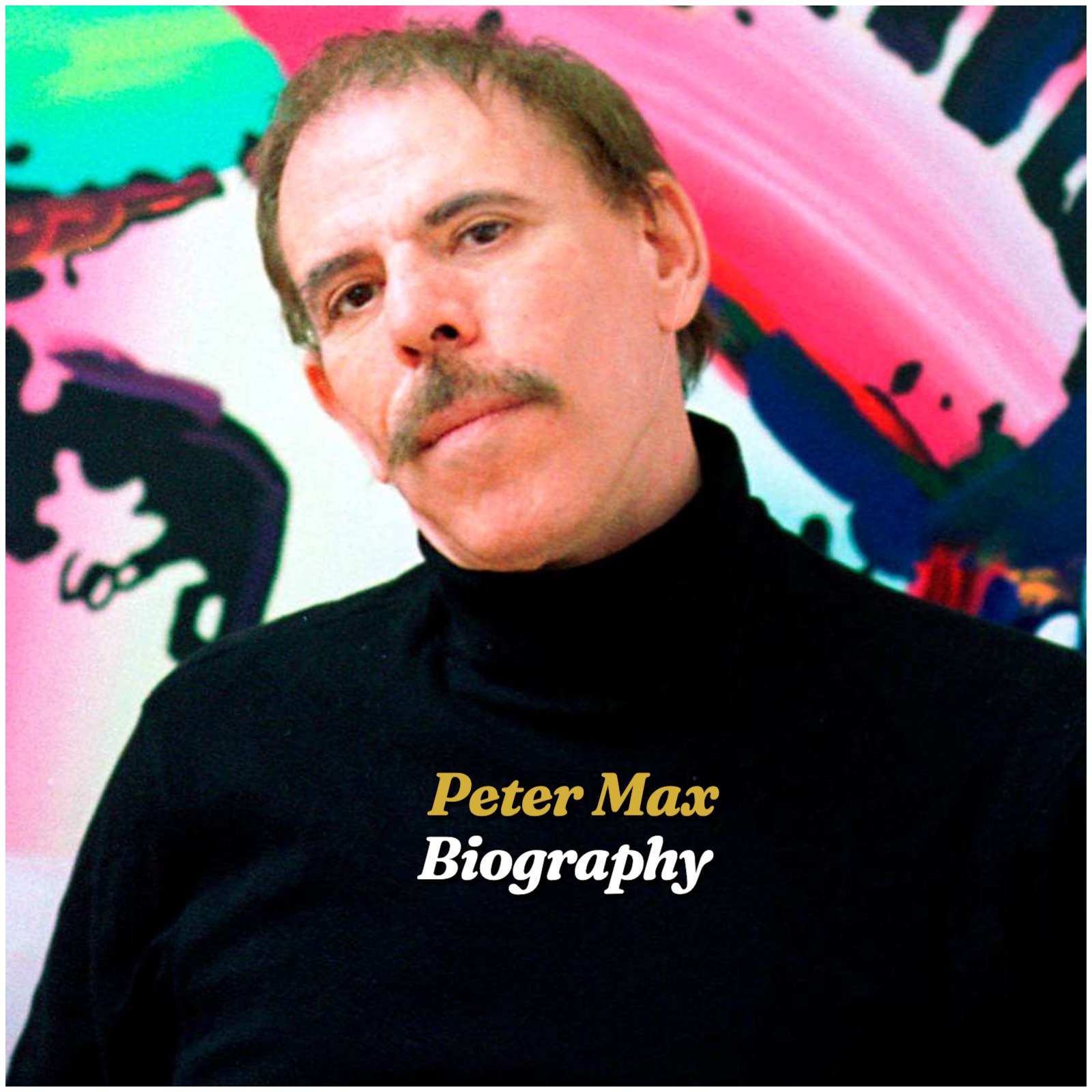
Peter Max was a German born American artist best known for his colorful psychedelic artwork that became closely associated with the visual culture of the 1960s. Born Peter Max Finkelstein on October 19, 1937, in Berlin, Germany, he developed a distinctive artistic style built around vivid colors, cosmic imagery, flowers, rainbows, stars and symbolic figures. His work eventually became recognizable across paintings, posters, commercial products and major public events.
Max became one of the most commercially recognizable artists of his generation after emerging prominently in the late 1960s. His artwork appeared on posters, clothing, household products, magazine covers, postage stamps, airplanes and other widely seen objects. He also created artwork for major events including the Olympics, Super Bowl, World Cup, World Series and Indianapolis 500.
Beyond his commercial success, Peter Max developed a reputation as an artist whose work represented optimism, peace, freedom and the counterculture spirit of the 1960s. His career lasted for decades and included painting, graphic design, public art and portraiture. In September 2026, Max attracted renewed global attention after his death at the age of 88 in Manhattan.
Peter Max’s Early Life
Peter Max was born Peter Max Finkelstein on October 19, 1937, in Berlin, Germany, to Jewish parents Salla and Jakob Finkelstein. When he was still a baby, his family fled Nazi Germany and moved to Shanghai, China. He spent about a decade in Shanghai, where the colorful surroundings, Buddhist art, Chinese calligraphy and American popular culture influenced his developing artistic interests.
In 1948, Max and his family moved to Haifa, Israel, where he continued developing his interest in drawing and painting. He took art lessons and also developed a fascination with astronomy. His interest in the cosmos later became an important influence on the planets, stars, galaxies and other space related imagery that appeared throughout his artwork.
Max and his family later spent time in Paris before moving to the United States. They eventually settled in Brooklyn, New York, when Max was 16. His exposure to different cultures during his childhood and teenage years gave him a broad visual background that later became part of his distinctive artistic identity.
Peter Max’s Education
Peter Max completed high school in Brooklyn after his family settled in New York. His interest in art had already developed considerably by this stage, and he decided to pursue formal artistic training rather than follow a conventional academic path. His early artistic education focused on drawing, anatomy, composition and traditional painting techniques.
In 1956, Max began studying at the Art Students League of New York in Manhattan. He studied anatomy, figure drawing and composition under Frank J. Reilly, who had also been associated with the artistic tradition of Norman Rockwell. This training gave Max a strong foundation in realistic drawing before he eventually developed the highly stylized visual language that made him famous.
Max also studied at the School of Visual Arts and Pratt Institute. His education combined traditional fine art training with the technical and commercial skills that would later help him succeed in graphic design and advertising. This combination became important to his career because he eventually moved between fine art, commercial design and mass media.
Peter Max’s Career
Peter Max began his professional career in graphic design during the late 1950s and early 1960s. In 1961, he opened a graphic design studio with friends and began creating work for advertising agencies, publications and businesses. His bold designs quickly attracted attention, allowing him to establish himself within the competitive New York commercial art industry.
Max’s career changed dramatically during the 1960s when he developed the colorful, psychedelic style that became his signature. His artwork featured bright colors, cosmic landscapes, flowers, stars, planets, rainbows and stylized human figures. The work became closely connected with the youth culture of the era and helped make Max one of the most recognizable visual artists of the period.
His artwork soon expanded beyond traditional paintings and posters. Max licensed his designs for clothing, household goods, clocks, mugs, bedding, stationery and other products. His images appeared on magazine covers, album related material, postage stamps and even aircraft and cruise ships. His ability to combine fine art with mass commercial distribution made him an unusually prominent figure in American popular culture.
Max also became involved in major public events and cultural projects. He served as an official artist for events including the Olympics, Super Bowl, Indianapolis 500, World Cup and World Series. He created public artwork, portraits of major political and cultural figures and several notable works connected with the Statue of Liberty. In 1981, he was invited to the White House by first lady Nancy Reagan to create a series of Statue of Liberty paintings.
Although Max became extremely successful commercially, he eventually became concerned that his business activities had taken him away from painting. He reduced his commercial operations during the early 1970s and returned more strongly to fine art. He continued producing paintings, portraits and public artwork for decades, maintaining a recognizable visual style while working with galleries, collectors, celebrities and major organizations.
Peter Max Dies at 88 After Years of Declining Health
Peter Max died on September 14, 2026, at a hospital in Manhattan at the age of 88. His son Adam Max confirmed his death, and news of his passing quickly drew international attention because of Max’s longstanding influence on American popular culture and the visual identity of the 1960s.
The precise cause of death was not publicly disclosed in the initial announcement. Reports stated that Max had experienced advanced dementia in his later years, with some accounts describing the condition as Alzheimer’s disease. His declining health had significantly affected his ability to continue painting during the final years of his life.
Max’s death marked the end of the life of an artist whose work had remained recognizable for generations. His colorful images continued to circulate through galleries, licensed products, exhibitions and collectors long after his greatest commercial success in the 1960s and 1970s.
Peter Max’s Personal Life
Peter Max was married twice. His first marriage was to Elizabeth Nance, and the couple had two children, Adam Cosmo Max and Libra Astro Max. Their marriage later ended in divorce. Max subsequently had relationships with model Rosie Vela and actress Tina Louise before meeting Mary Balkin.
Max married Mary Balkin in 1997. Their marriage later became connected to highly publicized family and legal disputes concerning his finances, artwork and personal affairs. In 2019, Mary Max died by suicide amid ongoing legal difficulties and disputes surrounding Peter Max’s affairs.
Max was also known for his interest in yoga, meditation, vegetarianism and astronomy. He said he had stopped using drugs and alcohol in 1966 and often attributed his expanded artistic awareness to yoga and meditation rather than psychedelic drugs. His fascination with astronomy remained a recurring influence throughout his artistic career.
Peter Max’s Age, Religion, Nationality, Height and Physical Appearance
Peter Max was born on October 19, 1937, making him 88 years old at the time of his death in September 2026. He was born in Berlin, Germany, and spent portions of his childhood in Shanghai, Israel and France before eventually settling in the United States.
Max was born into a Jewish family and was of German Jewish background. His family fled Nazi Germany when he was a baby because of persecution, and his early experiences across several countries became part of the broader story of his life and artistic development.
Peter Max was German born and became an American citizen and prominent figure in American art. His exact height has not been consistently documented in reliable public biographical records. He was widely recognizable for his distinctive appearance, including his dark hair, prominent mustache and colorful personal style, particularly during the height of his fame in the 1960s and 1970s.
Peter Max’s Net Worth
Peter Max did not leave behind a universally verified public figure for his personal net worth. His financial success was substantial, however, particularly during the height of his commercial career. His artwork was licensed across numerous product categories, and his posters sold in the millions.
Max generated income through paintings, graphic design, commercial licensing, posters, public commissions, exhibitions and other artistic projects. At the peak of his commercial success, his business interests extended across dozens of product lines and generated significant revenue.
Based on the scale and length of his career, his commercial licensing activities, artwork sales and public commissions, Peter Max’s lifetime wealth would reasonably be estimated in the tens of millions of dollars. However, this is an estimate rather than a confirmed figure because his private assets, investments, artwork holdings and financial arrangements were not publicly disclosed in sufficient detail.
Peter Max’s Legacy
Peter Max’s legacy is strongly connected with the visual culture of the 1960s. His psychedelic imagery helped define the colorful aesthetic associated with the flower power movement, while his posters and commercial designs brought his artwork into homes and everyday life on a scale unusual for a fine artist.
His career also demonstrated how an artist could move between fine art and mass culture. Max created paintings and museum exhibited works while simultaneously licensing his designs for consumer products, creating public artwork and contributing to major sporting and cultural events. This approach made his work accessible to audiences far beyond traditional art collectors.
Max remained a recognizable cultural figure long after the height of the psychedelic art movement. His paintings, posters, commercial designs and recurring cosmic imagery continued to be collected and exhibited, while his influence remained visible in the way art, popular culture and commercial branding could intersect. His death in 2026 brought renewed attention to the extraordinary reach of his work and his place in American cultural history.
Conclusion
Peter Max was a German born American artist whose colorful psychedelic artwork became one of the defining visual expressions of the 1960s. From his early years across Europe, Asia and the Middle East to his rise as a graphic designer and internationally recognized artist, Max built a career that connected fine art with mass culture. He died in Manhattan at the age of 88 in September 2026, leaving behind a vast body of work and a visual legacy that continues to be associated with color, optimism, cosmic imagery and the cultural spirit of an era.
Frequently Asked Questions About Peter Max
Who was Peter Max?
Peter Max was a German born American artist known for his colorful psychedelic paintings, posters, graphic designs and commercial artwork that became closely associated with the culture of the 1960s.
What was Peter Max famous for?
Peter Max was famous for his bright psychedelic artwork featuring flowers, rainbows, stars, planets, cosmic landscapes and stylized figures. His designs became especially popular during the 1960s flower power movement.
When was Peter Max born?
Peter Max was born on October 19, 1937, in Berlin, Germany.
When did Peter Max die?
Peter Max died on September 14, 2026, at the age of 88 in Manhattan, New York.
What was Peter Max’s cause of death?
The precise cause of Peter Max’s death was not publicly disclosed. He had experienced advanced dementia and declining health during his later years.
How old was Peter Max when he died?
Peter Max was 88 years old when he died in September 2026.
What was Peter Max’s real name?
Peter Max’s birth name was Peter Max Finkelstein.
Where was Peter Max born?
Peter Max was born in Berlin, Germany.
Was Peter Max Jewish?
Yes. Peter Max was born into a Jewish family in Berlin. His family fled Nazi Germany when he was a baby.
What nationality was Peter Max?
Peter Max was German born and became an American artist and prominent figure in American culture.
Where did Peter Max study art?
Peter Max studied at the Art Students League of New York, the School of Visual Arts and Pratt Institute.
What style of art was Peter Max known for?
Peter Max was best known for psychedelic pop art characterized by vivid colors, cosmic imagery, flowers, stars, planets, rainbows and stylized figures.
What influenced Peter Max’s artwork?
Peter Max was influenced by astronomy, Chinese art and calligraphy, Buddhist imagery, traditional painting, Fauvism, popular culture and the visual culture of the 1960s.
Did Peter Max design for the Olympics?
Yes. Peter Max served as an official artist for the Olympics and several other major sporting and cultural events.
Did Peter Max design artwork for the Super Bowl?
Yes. Peter Max created artwork connected with multiple Super Bowl events.
Did Peter Max paint the Statue of Liberty?
Yes. Peter Max created a notable series of Statue of Liberty paintings and was invited to the White House in 1981 to work on the series.
Was Peter Max married?
Yes. Peter Max was married twice. His first marriage was to Elizabeth Nance, and his second marriage was to Mary Balkin.
Did Peter Max have children?
Yes. Peter Max had two children, Adam Cosmo Max and Libra Astro Max, from his first marriage.
What was Peter Max’s net worth?
Peter Max’s exact net worth was not publicly verified. Based on his decades of artwork sales, commercial licensing, public commissions and other professional activities, his lifetime wealth can reasonably be estimated in the tens of millions of dollars.
What happened to Peter Max’s artwork?
Peter Max’s artwork continues to be exhibited, collected and sold through galleries and the Peter Max Studio. His paintings, posters and graphic works remain part of his artistic legacy.
Did Peter Max have dementia?
Yes. Peter Max experienced advanced dementia during his later years, and reports stated that his health had significantly declined before his death.
What is Peter Max’s legacy?
Peter Max’s legacy is centered on his role in popularizing psychedelic art and creating a colorful visual identity associated with the 1960s. His work also demonstrated how fine art could reach mass audiences through posters, products, public projects and popular culture.