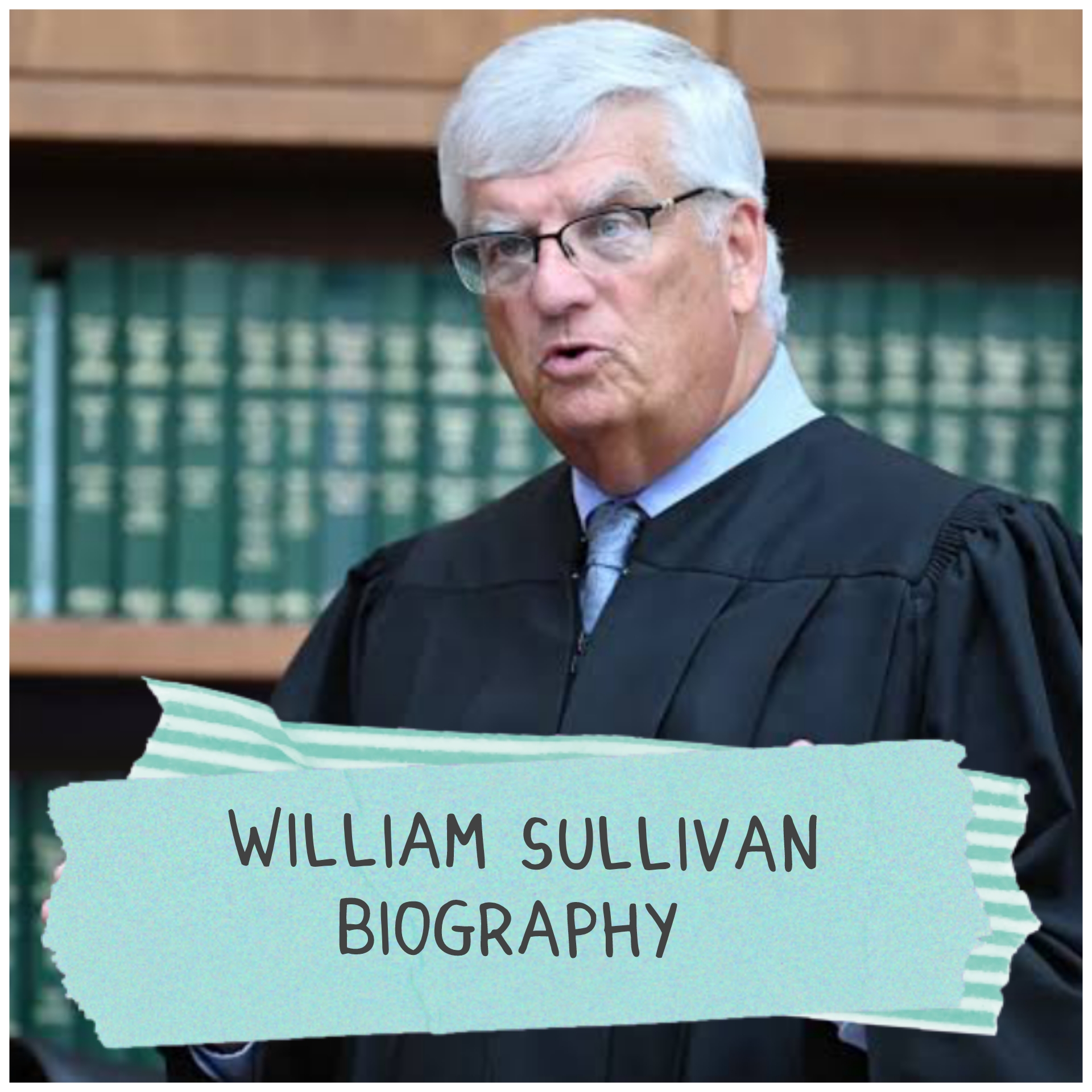
William F. Sullivan is an American lawyer and Massachusetts Superior Court judge who has attracted national attention for presiding over several high-profile criminal cases. Born on June 15, 1957, in Boston, Massachusetts, Sullivan built a legal career spanning more than four decades, working first as a prosecutor, then as a criminal defense attorney and eventually as a judge.
Sullivan became particularly well known outside Massachusetts because of his work on major murder cases involving questions of mental illness and criminal responsibility. Before becoming a judge, he represented Nathaniel Fujita, a Massachusetts man convicted of murdering his former girlfriend, Lauren Astley, and mounted an insanity-related defense based on psychosis.
In 2026, Sullivan became the focus of renewed national attention while presiding over the highly publicized murder trial of Lindsay Clancy, a Massachusetts mother accused of killing her three children. The six-week trial ended in a mistrial on September 4, 2026, after the jury failed to reach a unanimous verdict, placing Sullivan at the center of one of the most closely watched criminal cases in the United States.
William Sullivan Profile Summary
| Category | Details |
| Full Name | William Francis Sullivan |
| Date of Birth | June 15, 1957 |
| Age | 69 years old |
| Place of Birth | Boston, Massachusetts, United States |
| Nationality | American |
| Profession | Lawyer and Judge |
| Current Position | Associate Justice, Massachusetts Superior Court |
| Appointment | May 21, 2014 |
| Appointed By | Governor Deval Patrick |
| Education | University of Notre Dame; Boston College Law School |
| Undergraduate Degree | Bachelor’s degree |
| Law Degree | Juris Doctor |
| High School | Xaverian Brothers High School |
| Former Career | Prosecutor and Criminal Defense Attorney |
| Wife | Mary Lou Sullivan |
| Children | Three sons |
| Known Children | Will, Conor and Brennan |
| Religion | Not reliably documented |
| Net Worth | Not publicly verified |
| Retirement Age | 70 under Massachusetts judicial rules |
William Sullivan Early Life
William Francis Sullivan was born on June 15, 1957, in Boston, Massachusetts. He grew up in the Boston area and attended Xaverian Brothers High School in Westwood, Massachusetts, a Catholic college-preparatory school. His upbringing in the Boston region would eventually lead him into a long career within the Massachusetts legal system.
Sullivan also developed a strong interest in sports during his youth. He went on to attend the University of Notre Dame, where he played soccer for the Fighting Irish men’s soccer team. His time as a student-athlete became an important part of his background, and he has remained known as a sports fan throughout his adult life.
His family also had strong connections to Massachusetts. His father, William H. Sullivan, was a physician and orthopedic surgeon who worked in the Canton area. His father’s death in 2017 was reported by Massachusetts newspapers, which identified William F. Sullivan as his son and described his own career as a judge.
William Sullivan Education
Sullivan attended Xaverian Brothers High School before enrolling at the University of Notre Dame. At Notre Dame, he played men’s soccer and completed his undergraduate education, graduating with a bachelor’s degree in 1979.
His experience at Notre Dame was significant not only academically but also personally. Playing collegiate soccer gave him experience in a competitive team environment, and his interest in sports has remained part of his identity outside the courtroom.
After completing his undergraduate degree, Sullivan attended Boston College Law School. He earned his Juris Doctor in 1982 and began his legal career shortly afterward. His legal education placed him on a path toward criminal law, eventually taking him from prosecution to defense work and, later, the bench.
William Sullivan Legal Career
Beginning as a Prosecutor
Sullivan began practicing law in 1982 after completing Boston College Law School.
His first major professional position was as an assistant district attorney in the Norfolk County District Attorney’s Office. He spent approximately two years as a prosecutor, gaining firsthand experience representing the government in criminal proceedings.
Working as a prosecutor gave Sullivan an understanding of criminal cases from the state’s perspective. He dealt with investigations, criminal charges, evidence and courtroom proceedings before eventually moving into private practice.
Transition to Criminal Defense
After his time as a prosecutor, Sullivan moved into private criminal defense practice.
The transition gave him experience on the opposite side of the courtroom. Rather than representing the government, he began representing people accused of serious crimes.
Over the following decades, Sullivan developed a reputation as an experienced criminal defense attorney, particularly in complex and serious criminal cases.
His background on both sides of criminal litigation later became an important feature of his judicial career. By the time he became a judge, he had experienced criminal trials as a prosecutor, defense attorney and eventually as the person responsible for overseeing proceedings from the bench.
Nathaniel Fujita Case
One of Sullivan’s most notable cases before becoming a judge was his defense of Nathaniel Fujita.
Fujita was a young Massachusetts man accused of murdering his former high school girlfriend, Lauren Astley, in 2011. The case attracted considerable attention because Fujita and Astley were young people from relatively affluent Boston-area communities, and the circumstances surrounding Astley’s death shocked the local community.
Sullivan represented Fujita during his 2013 trial.
The defense did not primarily attempt to dispute that Fujita had killed Astley. Instead, Sullivan argued that Fujita had experienced a psychotic episode and that his mental state affected his ability to understand or control his actions.
The jury ultimately rejected the defense and convicted Fujita. He was sentenced to life in prison without the possibility of parole.
The case nevertheless became significant in Sullivan’s career because it demonstrated his willingness to pursue a difficult mental-health defense in a serious murder prosecution.
Sullivan’s Views on Mental Illness and Criminal Responsibility
The Fujita case also provided an unusually public look at Sullivan’s thinking about mental illness and criminal behavior.
In an interview connected to a television documentary about the case, Sullivan discussed the difficulty jurors can have in understanding how severe mental illness can affect a person’s behavior.
His comments emphasized that psychosis does not always look like the stereotypical image of someone who is obviously detached from reality. That experience became particularly relevant years later when Sullivan presided over another murder case in which mental illness and criminal responsibility were central issues.
Appointment to the Massachusetts Superior Court
After decades as a practicing criminal lawyer, Sullivan was appointed to the Massachusetts Superior Court by Governor Deval Patrick.
He assumed office on May 21, 2014.
The appointment represented a major transition from advocacy to judicial decision-making. As an attorney, Sullivan’s role was to advocate for his client’s interests. As a judge, he became responsible for managing proceedings, ruling on evidence and legal arguments, instructing juries and ensuring that trials follow Massachusetts law.
Sullivan subsequently served in several Massachusetts counties and became an experienced Superior Court judge handling serious criminal matters.
High-Profile Murder Cases
Sullivan has presided over several cases that attracted substantial public attention.
His experience with criminal defense, particularly cases involving mental health, has made his courtroom role especially notable when defendants raise questions about insanity or lack of criminal responsibility.
One of the most significant cases involved Latarsha Sanders, a Massachusetts mother convicted of murdering her two young sons.
Sanders’ defense involved mental illness, including claims concerning paranoia and schizophrenia. Sullivan presided over the trial and made evidentiary decisions concerning thousands of pages of medical records.
In 2026, the Massachusetts Supreme Judicial Court overturned Sanders’ convictions and ordered a new trial. The state’s highest court concluded that Sullivan had made a prejudicial error by excluding important mental-health records that could have supported the defense.
The decision became an important part of the public discussion surrounding Sullivan’s judicial record, particularly because it occurred shortly before the conclusion of the Lindsay Clancy trial.
Lindsay Clancy Trial
Why William Sullivan Became Nationally Known
William Sullivan became nationally recognizable in 2026 because he presided over the murder trial of Lindsay Clancy.
Clancy was accused of killing her three children at the family’s home in Duxbury, Massachusetts, in January 2023. She admitted to killing the children but pleaded not guilty on the basis that she was not criminally responsible because of severe postpartum psychosis and other mental-health complications.
The case became one of the most closely watched criminal trials in Massachusetts.
It attracted attention not only because of the deaths of the children but also because it raised broader questions about postpartum mental illness, psychiatric treatment, medication, criminal responsibility and the legal definition of insanity.
Sullivan’s Role During the Trial
As the presiding judge, Sullivan controlled courtroom procedure and ruled on legal disputes between prosecutors and defense attorneys.
The trial lasted approximately six weeks and involved testimony from family members, medical professionals, mental-health experts, police officers and other witnesses.
Sullivan’s previous experience with the Fujita case made his role particularly notable because that earlier case had also involved a defendant accused of murder whose defense centered heavily on psychosis.
The similarities did not mean the two cases had the same legal facts or outcomes, but Sullivan’s previous experience became a major topic of interest during the Clancy proceedings.
The Jury Deadlock
After extensive testimony, the Clancy jury began deliberations.
The jurors repeatedly informed Sullivan that they were unable to reach a unanimous verdict. Sullivan instructed them to continue deliberating rather than immediately ending the trial.
The deliberations eventually lasted roughly 38 hours.
At one point, defense attorneys sought the removal of a juror whom they argued was unwilling to properly apply the legal standard of reasonable doubt. Sullivan declined to remove the juror after determining that the juror had affirmed the ability to follow the court’s instructions.
Mistrial
On September 4, 2026, Sullivan declared a mistrial after the jury remained deadlocked.
The jury was reportedly split 11–1 and could not reach the unanimity required for a verdict.
Sullivan’s decision did not determine whether Clancy was guilty or not guilty. A mistrial simply meant that the jury had failed to reach a legally sufficient verdict.
The case therefore remained unresolved, with prosecutors facing decisions about whether to seek a retrial or pursue another legal resolution.
A further court hearing was scheduled for September 29, 2026.
William Sullivan Trending: Why Is William Sullivan Famous?
William Sullivan is trending because he presided over the Lindsay Clancy murder trial, one of the most closely followed criminal cases in the United States in 2026.
Interest in Sullivan increased dramatically after he declared a mistrial on September 4 following the jury’s failure to reach a unanimous verdict.
His background has also attracted attention because he previously worked as a criminal defense attorney and once represented Nathaniel Fujita in a murder case involving an insanity and psychosis defense.
The timing has generated additional scrutiny because the Massachusetts Supreme Judicial Court had overturned the conviction in another mental-health-related murder case, Latarsha Sanders, only weeks before the Clancy mistrial.
William Sullivan Age, Religion, Nationality, Height and Physical Appearance
William Sullivan was born on June 15, 1957, in Boston, Massachusetts. He is 69 years old as of September 2026 and is an American citizen.
Sullivan’s height has not been reliably documented in authoritative public biographies. Although photographs and courtroom footage provide a general impression of his physical appearance, an exact height should not be treated as confirmed.
His religion has also not been reliably documented in public sources. His education at Xaverian Brothers High School and his time at Notre Dame are part of his documented background, but they should not automatically be treated as proof of his current personal religious beliefs.
William Sullivan Personal Life
William Sullivan is married to Mary Lou Sullivan. The couple have three sons named Will, Conor and Brennan. Sullivan has generally kept his family life private compared with the considerable public attention surrounding his professional work.
Reports about Sullivan’s life outside the courtroom describe him as a major sports fan. His history as a Notre Dame soccer player also explains his long-standing connection to athletics.
Sullivan’s father, William H. Sullivan, was an orthopedic physician who died in 2017. His father’s obituary identified William F. Sullivan and his wife Mary Lou among the surviving family members. Beyond his immediate family, Sullivan has generally maintained a low public profile.
William Sullivan Net Worth
William Sullivan’s exact net worth is not publicly verified. There is no reliable public financial record that establishes his total assets, investments, property holdings and liabilities sufficiently to produce a credible personal net-worth figure.
His primary professional income has come from a long legal career spanning private criminal defense work and more than a decade as a Massachusetts Superior Court judge.
Because judges’ salaries do not represent their entire personal wealth, and because Sullivan’s private assets and investments are not comprehensively public, online claims assigning him a specific net worth should be treated cautiously.
Retirement and Judicial Future
Massachusetts state judges are subject to mandatory retirement at age 70.
Because Sullivan was born in June 1957, he is approaching that statutory retirement age in 2027.
This makes the 2026 period particularly significant in his judicial career. His handling of the Clancy trial, along with the controversy surrounding the Sanders case, has placed his record under unusual public scrutiny during the final stage of his time on the Massachusetts Superior Court.
His retirement will mark the end of a legal career that began in 1982 and moved through prosecution, private criminal defense and judicial service.
Legacy
William Sullivan’s legal legacy is still developing, but his career already reflects three distinct perspectives within the American criminal justice system. He has worked as a prosecutor, represented criminal defendants as a defense lawyer and spent more than a decade making decisions as a judge.
His defense of Nathaniel Fujita established his reputation in high-profile criminal litigation involving mental illness. His later judicial work placed him on the other side of similar legal questions, where he became responsible for ensuring that both prosecution and defense operated within the rules of the courtroom.
The Lindsay Clancy trial will likely become one of the defining cases associated with Sullivan’s judicial career. The September 2026 mistrial, combined with the earlier appellate reversal in the Sanders case, means that his handling of mental-health-related criminal proceedings will remain an important part of how his professional record is discussed.
Conclusion
William F. Sullivan is a Massachusetts Superior Court judge and veteran criminal lawyer whose career has taken him from prosecution to criminal defense and ultimately to the bench. A 1979 Notre Dame graduate and 1982 Boston College Law School graduate, he spent decades practicing criminal law before Governor Deval Patrick appointed him to the Superior Court in 2014. His previous defense of Nathaniel Fujita and his subsequent handling of major murder cases have made him particularly associated with difficult questions surrounding mental illness and criminal responsibility. In 2026, Sullivan became nationally known for presiding over the Lindsay Clancy murder trial, which ended in a mistrial after a deadlocked jury failed to reach a unanimous verdict. With mandatory judicial retirement approaching in 2027, the cases he has handled — and the legal decisions surrounding them — are likely to form a significant part of his professional legacy.
Frequently Asked Questions About William Sullivan
Who is William Sullivan?
William F. Sullivan is an American lawyer and Massachusetts Superior Court judge. He has worked as a prosecutor, criminal defense attorney and judge during a legal career spanning more than four decades.
How old is William Sullivan?
William Sullivan is 69 years old as of September 2026. He was born on June 15, 1957.
Where was William Sullivan born?
William Sullivan was born in Boston, Massachusetts, United States.
What does William Sullivan do?
William Sullivan is an associate justice of the Massachusetts Superior Court. He presides over criminal and civil cases within the Massachusetts court system.
When did William Sullivan become a judge?
Sullivan was appointed to the Massachusetts Superior Court by Governor Deval Patrick and assumed office on May 21, 2014.
What did William Sullivan do before becoming a judge?
Before becoming a judge, Sullivan worked as an assistant district attorney and later spent decades as a private criminal defense attorney.
What school did William Sullivan attend?
William Sullivan attended Xaverian Brothers High School in Westwood, Massachusetts, before attending the University of Notre Dame.
Where did William Sullivan go to college?
Sullivan attended the University of Notre Dame, where he played men’s soccer and earned his bachelor’s degree in 1979.
Where did William Sullivan study law?
William Sullivan earned his Juris Doctor from Boston College Law School in 1982.
Is William Sullivan married?
Yes. William Sullivan is married to Mary Lou Sullivan.
Does William Sullivan have children?
Yes. William Sullivan and his wife Mary Lou have three sons: Will, Conor and Brennan.
Who is William Sullivan’s father?
William Sullivan’s father was William H. Sullivan, an orthopedic physician who practiced in Massachusetts.
What happened in the Lindsay Clancy trial?
The Lindsay Clancy trial ended in a mistrial on September 4, 2026, after the jury failed to reach a unanimous verdict. William Sullivan was the presiding judge.
Why did William Sullivan declare a mistrial?
Sullivan declared a mistrial because the jury remained deadlocked and could not reach the unanimous verdict required to resolve the criminal charges.
Was Lindsay Clancy found guilty?
No. Lindsay Clancy was not found guilty because the jury failed to reach a unanimous verdict. The case ended in a mistrial rather than a conviction or acquittal.
What other famous case did William Sullivan handle?
Before becoming a judge, Sullivan defended Nathaniel Fujita, who was convicted of murdering Lauren Astley. Sullivan pursued a defense centered on Fujita’s mental state and alleged psychosis.
What happened to Nathaniel Fujita?
Nathaniel Fujita was convicted of murdering Lauren Astley and sentenced to life in prison without the possibility of parole.
What happened in the Latarsha Sanders case?
Latarsha Sanders was convicted of murdering her two sons, but the Massachusetts Supreme Judicial Court overturned the convictions in 2026 after finding that important mental-health records had been improperly excluded from the trial.
How old is William Sullivan’s wife?
Mary Lou Sullivan’s exact age has not been reliably documented in public sources.
What is William Sullivan’s religion?
William Sullivan’s current religion has not been reliably documented in authoritative public sources.
How tall is William Sullivan?
William Sullivan’s exact height has not been reliably documented.
What is William Sullivan’s net worth?
William Sullivan’s exact net worth is not publicly verified. Although he has had a long and successful legal career, his personal assets, investments and liabilities are not publicly documented in enough detail to calculate a reliable figure.
When will William Sullivan retire?
Massachusetts judges are subject to mandatory retirement at age 70. Since Sullivan was born in June 1957, he is expected to reach the mandatory retirement age in 2027.
Why is William Sullivan famous?
William Sullivan is best known publicly for his work as a Massachusetts Superior Court judge and for presiding over high-profile criminal cases, particularly the 2026 Lindsay Clancy murder trial.