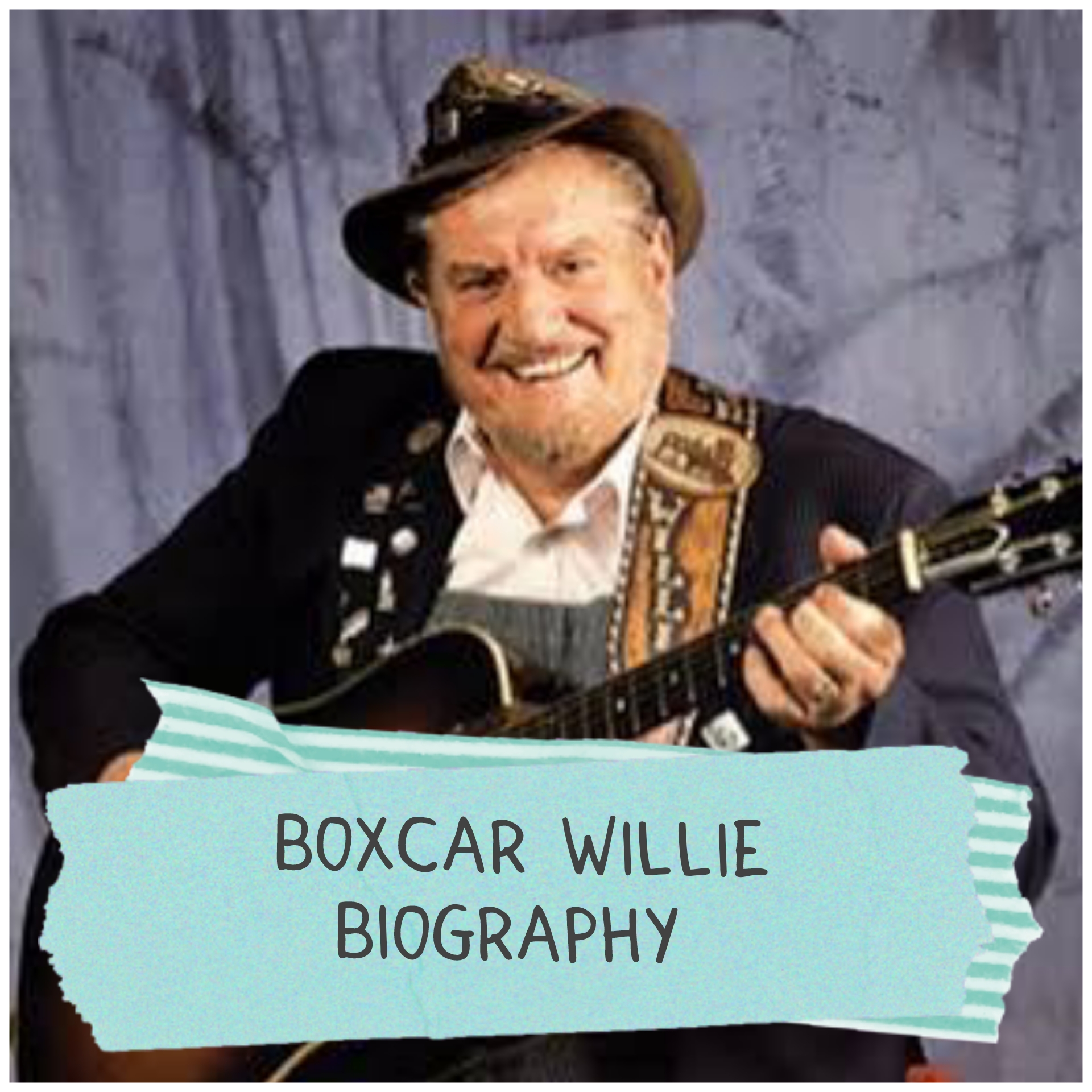
Boxcar Willie was an American country music singer and songwriter best known for his distinctive hobo persona, train-whistle imitation and old-fashioned country style. Born Lecil Travis Martin, he became one of the most recognizable figures in traditional country music after adopting the Boxcar Willie character in the 1970s.
Unlike many country stars who achieved fame in their twenties or thirties, Boxcar Willie found his biggest success later in life. His career took him from small country-music performances and military service to international fame, television appearances, the Grand Ole Opry and a successful entertainment business in Branson, Missouri.
Boxcar Willie died in 1999 at the age of 67 after battling leukemia. Although he never became a major American singles-chart star, his distinctive personality, successful albums, international following and role in establishing Branson as a country-music destination secured his place in country music history.
Boxcar Willie Profile Summary
| Category | Details |
| Full Name | Lecil Travis Martin |
| Stage Name | Boxcar Willie |
| Date of Birth | September 1, 1931 |
| Place of Birth | Sterrett, Texas, United States |
| Date of Death | April 12, 1999 |
| Age at Death | 67 years |
| Profession | Singer and songwriter |
| Music Genre | Country, gospel |
| Famous For | Hobo persona, train-whistle imitation and traditional country music |
| Wife | Lloene Sue Johnson |
| Children | Four |
| Military Service | United States Air Force |
| Years of Service | 1949–1970s |
| Grand Ole Opry | Member from 1981 |
| Height | Not reliably documented |
| Nationality | American |
| Religion | Not reliably documented |
| Cause of Death | Leukemia |
| Net Worth | Not publicly documented |
Boxcar Willie Early Life
Lecil Travis Martin was born on September 1, 1931, in Sterrett, Texas, and was the eldest son of Birdie Brown and Edna Jones Martin. His father worked for the railroad and also played the fiddle, while music and the railroad environment became important influences during Lecil’s childhood.
The Martin family lived close to railroad tracks, and Lecil grew up around freight trains and the hobos who traveled on them during the Great Depression. His mother sometimes provided food to travelers who came to the family home, while his father occasionally rode freight trains with people looking for work. As a teenager, Lecil himself rode the rails.
Music was also present in his household. He grew up listening to country and gospel music and became particularly interested in the Grand Ole Opry, Jimmie Rodgers and other early country performers. By his teenage years, he was already performing at local country-music venues and radio programs around Texas.
Boxcar Willie Education
Boxcar Willie’s formal educational history is not extensively documented in reliable biographical sources. His youth was primarily shaped by his family environment, music and his early interest in performing.
As a teenager, Martin was already pursuing music alongside his education. He performed at country-music events and eventually appeared on the Big D Jamboree, a Dallas radio program, at about 17 years old.
His professional development came largely through practical experience rather than formal musical education. Listening to established country performers, performing in clubs and working in radio helped him develop the singing style that later became the foundation of his Boxcar Willie persona.
Boxcar Willie Career
Boxcar Willie’s career was unusually long and varied. Before achieving national recognition as a singer, he spent more than two decades in the U.S. Air Force and worked in radio. His eventual transformation into the fictional singing hobo character Boxcar Willie turned him into a successful entertainer.
Boxcar Willie and the U.S. Air Force
In 1949, Lecil Martin joined the United States Air Force. He served for more than two decades, including work as a flight engineer, while continuing to maintain his connection to music.
During his military years, he occasionally performed under names including Marty Martin. His military career provided financial stability while his music career remained uncertain.
After leaving active military service, Martin returned more seriously to entertainment. He worked in radio and continued performing while searching for a musical identity that could distinguish him from the many other country singers of the era.
How Lecil Martin Became Boxcar Willie
The Boxcar Willie character emerged during the 1970s. Martin had written a song called “Boxcar Willie,” inspired by the world of hobos and railroad travelers.
In the mid-1970s, he decided to build an entire stage persona around the character. He adopted striped overalls, a worn hat, scruffy appearance and a guitar, creating the image of an old-fashioned singing hobo.
One of the character’s most memorable features was Martin’s remarkably convincing imitation of a train whistle. His songs frequently dealt with trains, life on the road, working-class America and the romanticized freedom of the railroad.
Boxcar Willie’s Breakthrough
Martin’s major breakthrough came in 1976 when he was asked to replace George Jones at a Nashville club. A Scottish booking agent, Drew Taylor, saw the performance and invited Boxcar Willie to tour Britain.
The British audience responded enthusiastically to his old-fashioned American country persona. His popularity in the United Kingdom grew rapidly, eventually leading to a major performance at the International Country Music Festival at Wembley in 1979.
His British success helped him return to the United States with a much larger audience and a distinctive identity that separated him from mainstream country performers.
Boxcar Willie and King of the Road
One of Boxcar Willie’s most important commercial successes was King of the Road. The album became particularly successful in Britain, where it remained at the top of the country album chart for an extended period and eventually sold close to a million copies.
Television advertising played an important role in his success. His records were heavily promoted through television commercials, allowing fans to order the albums directly rather than relying entirely on conventional record-store distribution.
The strategy helped Boxcar Willie build a large audience even though he never became a dominant American singles-chart artist.
Boxcar Willie and the Grand Ole Opry
In 1981, Boxcar Willie became a member of the Grand Ole Opry. The achievement was particularly significant because the Opry represented one of the highest honors in traditional country music.
He also became a regular performer on the television program Hee Haw, further increasing his visibility among American country-music audiences.
His 1982 recording of “Bad News” became his most successful American country single, reaching the Top 40.
Boxcar Willie in Branson
Boxcar Willie became one of the important performers associated with the development of Branson, Missouri, into a major country-music tourist destination.
In 1986, he and his wife purchased a theater in Branson. The Boxcar Willie Theater opened the following year and became a successful attraction, with Martin sometimes performing multiple shows a day during the tourist season.
He eventually expanded his Branson business interests to include a train museum and motels. His theater became an important part of his later career and allowed him to continue performing even as his national recording career declined.
Boxcar Willie as an Actor
Boxcar Willie also appeared in films and television productions. One of his better-known acting appearances came in the 1985 film Sweet Dreams, a biographical movie about country singer Patsy Cline.
He also appeared in other productions, generally playing characters connected to his country-music persona.
Boxcar Willie Cause of Death and Death
Boxcar Willie was diagnosed with leukemia in 1996. Despite the diagnosis, he continued performing and working at his Branson theater after undergoing treatment.
He experienced a period of remission but later became seriously ill again. After a three-year battle with the disease, Boxcar Willie died on April 12, 1999, at his home in Branson, Missouri.
He was 67 years old. He was buried at Ozarks Memorial Park in Branson, where his death was widely mourned by the local community that had embraced him as one of the city’s pioneering country entertainers.
Boxcar Willie Personal Life
Boxcar Willie was married four times. His final and longest-lasting marriage was to Lloene Sue Johnson, whom he married after they had first met in the 1960s. The couple remained together until his death.
He had four children: Paula, Tammy, Larry and Lorrie. His son Larry later performed professionally and appeared alongside his father at the Boxcar Willie Theater in Branson.
Family remained an important part of Boxcar Willie’s later life and career. His children were involved in his entertainment activities, and his son Larry in particular worked with him at the Branson theater.
Boxcar Willie Age, Religion, Nationality, Height and Physical Appearance
Boxcar Willie was born on September 1, 1931, and died on April 12, 1999, at the age of 67. He was an American singer who spent most of his life in Texas and later became closely associated with Branson, Missouri.
His specific religious beliefs are not sufficiently documented in reliable public biographies to confidently identify his religion.
Boxcar Willie’s exact height is not reliably documented. He was instantly recognizable because of his trademark appearance: overalls, a floppy or battered hat, facial stubble, worn clothing and a guitar. The carefully constructed appearance was central to his singing-hobo character.
Boxcar Willie Net Worth
Boxcar Willie’s exact net worth at the time of his death has not been reliably documented. His income came from record sales, performances, television appearances, touring and his business ventures in Branson.
He enjoyed considerable commercial success, particularly through his albums and television marketing. Several of his records achieved gold or platinum sales, and his Branson theater provided another significant source of income.
However, there is no sufficiently reliable public financial record establishing a precise figure for his wealth. Claims giving an exact net worth should therefore be treated as speculation rather than a documented fact.
Boxcar Willie Legacy
Boxcar Willie left a distinctive mark on country music by reviving the image of the traditional American railroad hobo and turning it into a successful entertainment persona. His combination of old-fashioned country songs, train imagery, humor and his famous whistle imitation made him instantly recognizable.
He also played an important role in the growth of Branson as a country-music destination. His theater became one of the city’s attractions, and his success helped demonstrate the potential of Branson’s live-entertainment industry.
Perhaps most remarkably, Boxcar Willie proved that a country artist could achieve major success late in life. He became famous internationally after years of relative obscurity and remained active as a performer well into his sixties, leaving behind a career that was as unusual as the character he created.
Conclusion
Boxcar Willie transformed Lecil Travis Martin from a Texas-born musician and former Air Force serviceman into one of the most recognizable singing-hobo characters in country music. His late-career breakthrough, international popularity, Grand Ole Opry membership and pioneering role in Branson made him an unusual but enduring figure in American country music. Although he died of leukemia in 1999 at age 67, the character, songs and railroad-themed image he created continue to define his place in country-music history.
Frequently Asked Questions About Boxcar Willie
Who was Boxcar Willie?
Boxcar Willie was an American country singer and songwriter whose real name was Lecil Travis Martin. He became famous for performing as a singing hobo dressed in traditional railroad-worker-inspired clothing.
What was Boxcar Willie’s real name?
Boxcar Willie’s real name was Lecil Travis Martin.
When was Boxcar Willie born?
Boxcar Willie was born on September 1, 1931, in Sterrett, Texas.
How old was Boxcar Willie when he died?
Boxcar Willie was 67 years old when he died in 1999.
What was Boxcar Willie’s cause of death?
Boxcar Willie died from leukemia after battling the disease for approximately three years.
When did Boxcar Willie die?
Boxcar Willie died on April 12, 1999, in Branson, Missouri.
Who was Boxcar Willie’s wife?
Boxcar Willie’s final wife was Lloene Sue Johnson, whom he remained married to until his death.
How many children did Boxcar Willie have?
Boxcar Willie had four children: Paula, Tammy, Larry and Lorrie.
Was Boxcar Willie in the military?
Yes. Boxcar Willie served in the United States Air Force for more than 20 years and worked as a flight engineer.
Was Boxcar Willie a member of the Grand Ole Opry?
Yes. Boxcar Willie became a member of the Grand Ole Opry in 1981.
What was Boxcar Willie famous for?
He was famous for his singing-hobo persona, railroad-themed country songs, distinctive appearance and realistic imitation of a train whistle.
What was Boxcar Willie’s biggest hit?
“Bad News” became his most successful American country-chart single, while King of the Road was one of his most commercially successful albums, particularly in Britain.
Did Boxcar Willie own a theater?
Yes. Boxcar Willie and his wife purchased a theater in Branson, Missouri, in the 1980s. The venue became a major part of his later career.
Was Boxcar Willie a real hobo?
No. Boxcar Willie was a stage character created by Lecil Travis Martin. Martin had a genuine connection to railroads through his family and had ridden freight trains as a teenager, but he was not a professional hobo.
Did Boxcar Willie serve in the Air Force?
Yes. He joined the U.S. Air Force in 1949 and served for more than two decades.
How tall was Boxcar Willie?
Boxcar Willie’s exact height is not reliably documented.
What was Boxcar Willie’s religion?
His specific religion is not reliably documented in sufficient detail.
What was Boxcar Willie’s net worth?
His exact net worth was not publicly documented. He earned money from music, touring, recordings, television and his Branson businesses.
Where is Boxcar Willie buried?
Boxcar Willie is buried at Ozarks Memorial Park in Branson, Missouri.
What is Boxcar Willie’s legacy?
Boxcar Willie’s legacy lies in his distinctive singing-hobo character, traditional country music, international following, Grand Ole Opry membership and major contribution to the development of Branson as a country-music destination.