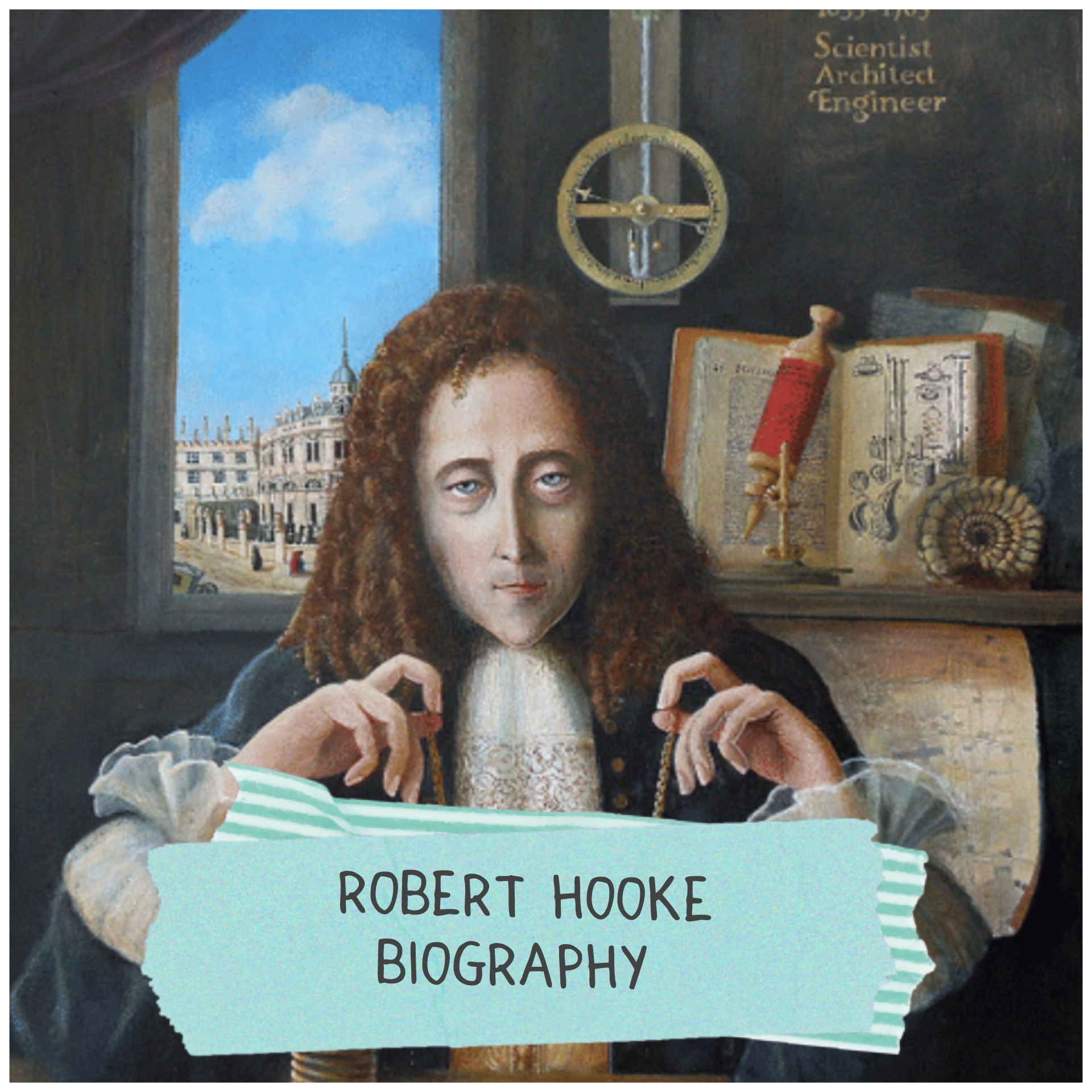
Robert Hooke was an English scientist, inventor, architect, mathematician and natural philosopher whose work contributed significantly to the development of modern science. He became one of the most influential scientific thinkers of seventeenth century England through his studies of nature, mechanics, astronomy, microscopy and architecture.
Hooke was born on July 18, 1635, in Freshwater on the Isle of Wight, England. He became particularly famous for his book Micrographia, published in 1665, which presented detailed observations of objects viewed through a microscope. His work helped make microscopy an important tool for scientific investigation.
He is also remembered for Hooke’s law of elasticity and for being the person who introduced the term “cell” into biology after observing the tiny compartments in cork under a microscope. Beyond science, Hooke played an important role in rebuilding London after the Great Fire of 1666 and worked closely with architect Christopher Wren.
Robert Hooke Early Life
Robert Hooke was born into a religious family on the Isle of Wight. His father, John Hooke, was a clergyman who served as a curate. Hooke was reportedly a delicate child and suffered from poor health during his early years, but he developed a strong interest in drawing, mechanics and scientific observation.
His early curiosity was encouraged by his ability to build and understand mechanical objects. He reportedly made models and experimented with different devices, showing an unusual talent for practical invention from a young age.
Hooke later left the Isle of Wight to continue his education in London. His intellectual abilities eventually brought him into contact with important scholars and scientists, setting the foundation for his later career at Oxford and the Royal Society.
Robert Hooke Education
Hooke received his early formal education at Westminster School in London. He studied under Richard Busby, an influential schoolmaster who helped develop Hooke’s abilities in mathematics, science and classical studies.
He later attended Christ Church, Oxford, where he became associated with a group of scholars interested in experimental science. During his time at Oxford, Hooke worked with scientists including Robert Boyle and became involved in practical scientific experiments.
Hooke received a Master of Arts from Oxford in 1663 and later received a Doctor of Medicine degree from Lambeth in 1691. His education was broad and practical, combining mathematics, mechanics, natural philosophy and experimental investigation.
Robert Hooke Career
Robert Hooke’s scientific career developed rapidly during the 1660s. He became Curator of Experiments for the newly established Royal Society in 1662, a position that required him to conduct demonstrations and experiments for members of the society. He was elected a Fellow of the Royal Society in 1663.
In 1665, Hooke published Micrographia, one of the most important scientific books of the seventeenth century. The book contained detailed drawings and descriptions of objects viewed through microscopes. His observations of cork led him to use the word “cell” because the structures reminded him of small rooms.
Hooke also made important contributions to physics. His work on elasticity resulted in what became known as Hooke’s law, which describes the relationship between the force applied to an elastic object and the amount by which it stretches. The principle remains important in physics and engineering.
His interests extended beyond biology and physics. Hooke conducted astronomical observations, developed scientific instruments and studied mechanical systems. He also worked as an architect and surveyor after the Great Fire of London in 1666, helping with the rebuilding of parts of the city alongside Christopher Wren.
Hooke later served as Secretary of the Royal Society from 1677 to 1679. Throughout his career, he was involved in numerous scientific debates, including disagreements with Isaac Newton over scientific discoveries and priority. Despite these controversies, Hooke remained one of the most versatile scientific thinkers of his period.
Robert Hooke’s Discoveries Continue to Shape Modern Science
Robert Hooke continues to attract attention because several of his scientific contributions remain fundamental to modern science. His work on elasticity became known as Hooke’s law, while his microscopic observations helped establish the importance of microscopy in studying biological structures.
His 1665 book, Micrographia, is particularly important because it demonstrated how powerful microscopes could be as scientific instruments. Hooke’s detailed illustrations allowed readers to see structures that could not be observed with the naked eye and helped encourage further scientific investigation at microscopic scales.
Hooke’s relationship with Isaac Newton has also contributed to continued interest in his life. Their disagreements over scientific ideas and priority became part of the history of the Scientific Revolution. Modern discussions of Hooke increasingly emphasize the wide range of his achievements rather than focusing only on his disputes with Newton.
Robert Hooke Death and Cause of Death
Robert Hooke died on March 3, 1703, at Gresham College in London. He was 67 years old at the time of his death. He had spent much of his later life dealing with declining health while continuing his scientific and intellectual work.
The exact medical cause of Hooke’s death has not been firmly established. Historical accounts describe several health problems during his later years, including blindness, swollen legs, chest pains and dizziness.
Some later writers have proposed possible conditions such as cardiovascular disease or diabetes, but there is no sufficiently reliable historical medical evidence to confirm a specific diagnosis. His exact cause of death therefore remains uncertain.
Robert Hooke Personal Life
Robert Hooke never married and did not have children. Much of his adult life was devoted to scientific research, experimentation, engineering, architecture and other intellectual pursuits.
Hooke was raised in an Anglican household because his father was a clergyman. His religious background existed alongside his strong interest in experimental science and natural philosophy.
He maintained professional relationships with many important figures of the period, including Robert Boyle, Christopher Wren and other members of the Royal Society. His working relationships sometimes became complicated by disagreements over scientific discoveries and recognition.
Robert Hooke Age, Religion, Tribe, Height and Physical Appearance
Robert Hooke was 67 years old when he died in 1703. He was born in England and belonged to the English population of the seventeenth century.
Hooke was raised within the Anglican Christian tradition through his family background. His father, John Hooke, was a clergyman, which gave religion an important place in his early upbringing.
His exact height has not been reliably recorded. Historical descriptions generally portray him as physically thin and somewhat stooped, with a curved spine. There are no reliable modern measurements that can establish his exact height.
Robert Hooke Net Worth
Robert Hooke’s exact net worth is unknown. Modern financial estimates cannot be reliably applied to a seventeenth century scientist because the value of money, professional income and economic systems were very different from those of today.
Hooke earned income through his scientific positions, experiments, surveying work, architectural projects and other professional activities. He held important positions connected to the Royal Society and also worked on rebuilding London.
Because there is no reliable historical record that establishes a modern equivalent of his wealth, any specific net worth figure would be speculative. His greatest measurable contribution was his scientific and intellectual legacy rather than a documented personal fortune.
Legacy
Robert Hooke left a major legacy across several fields of science. His work on elasticity became one of the foundational principles of physics, while his use of microscopy helped transform the study of biological structures.
His book Micrographia remains one of the most significant scientific publications of the seventeenth century. His observations helped demonstrate the hidden complexity of ordinary objects and contributed to the growing importance of experimental observation.
Hooke’s legacy also extends to architecture, astronomy, engineering and scientific instrumentation. Although some of his achievements were overshadowed for centuries by disputes involving Isaac Newton and other scientists, modern assessments increasingly recognize him as one of the most versatile thinkers of the Scientific Revolution.
Conclusion
Robert Hooke was a remarkably versatile English scientist whose contributions extended across physics, biology, astronomy, engineering, architecture and microscopy. His ability to combine observation with practical experimentation made him an important figure in the development of modern scientific thinking.
His discovery of microscopic structures, introduction of the term “cell,” work on elasticity and publication of Micrographia established achievements that continue to influence science centuries after his death.
Although many details of his personal life and death remain uncertain, Robert Hooke’s scientific legacy remains firmly established. His work demonstrates how observation, experimentation and curiosity can permanently change the way humanity understands the natural world.
Frequently Asked Questions
Who was Robert Hooke?
Robert Hooke was an English scientist, inventor, mathematician, architect and natural philosopher known for his work in microscopy, physics, astronomy and engineering.
When was Robert Hooke born?
Robert Hooke was born on July 18, 1635, in Freshwater on the Isle of Wight, England.
When did Robert Hooke die?
Robert Hooke died on March 3, 1703, at Gresham College in London.
How old was Robert Hooke when he died?
Robert Hooke was 67 years old when he died.
What was Robert Hooke famous for?
He was famous for Micrographia, Hooke’s law of elasticity, his microscopic observations and for introducing the term “cell” after observing cork.
Did Robert Hooke marry?
No. Robert Hooke never married and had no children.
What was Robert Hooke’s cause of death?
His exact cause of death is unknown. Historical accounts describe several health problems during his later years, but no specific medical diagnosis can be confirmed.
What did Robert Hooke discover?
Among his best known contributions were Hooke’s law of elasticity and his microscopic observations of biological structures, including the cork cells that inspired the term “cell.”
What is Robert Hooke’s legacy?
Robert Hooke is remembered as one of the most versatile scientists of the Scientific Revolution, with lasting contributions to physics, microscopy, biology, astronomy, engineering and architecture.