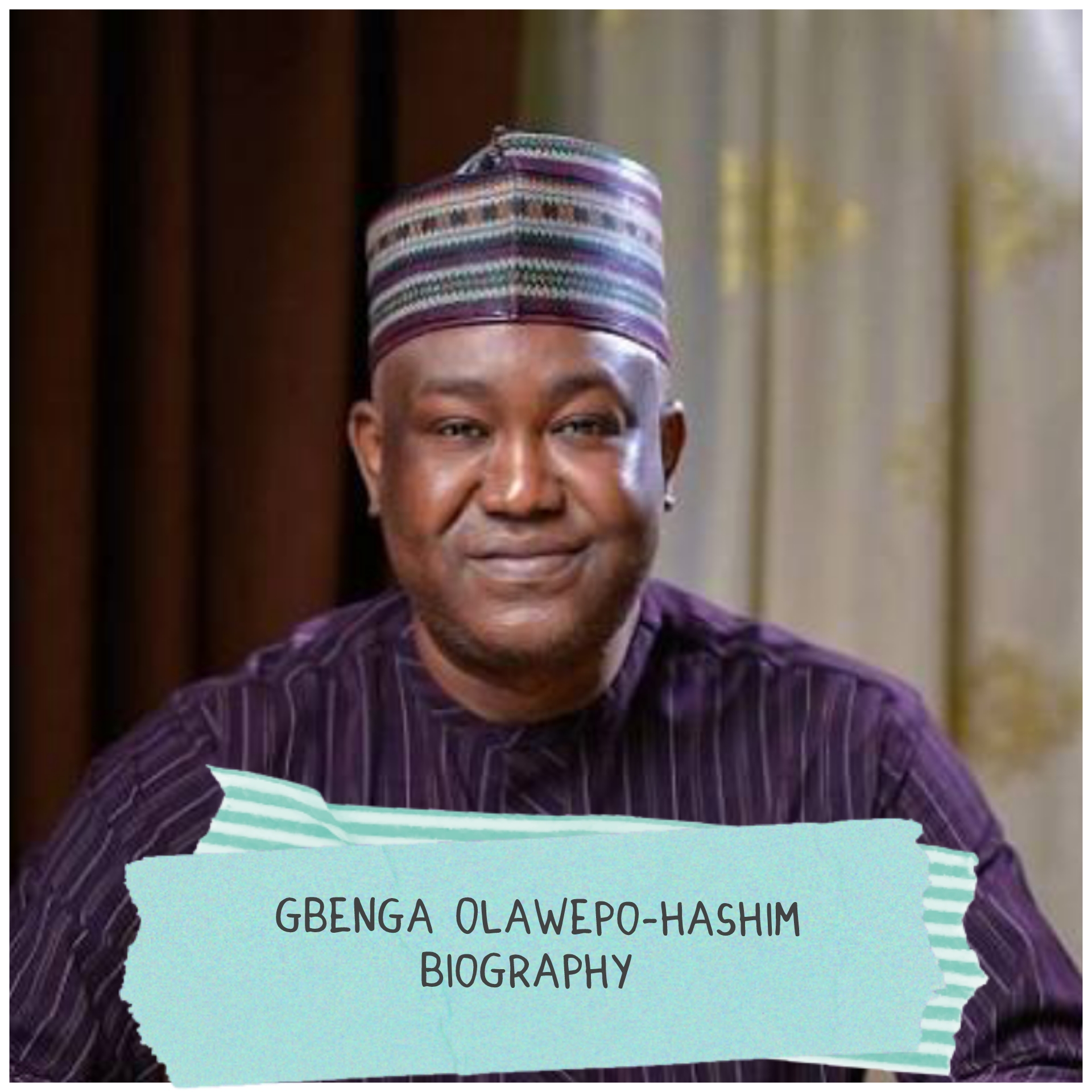
Gbenga Olawepo-Hashim is a Nigerian businessman, pro-democracy activist, politician, philanthropist and energy executive who has been involved in Nigeria’s political and public affairs for more than three decades. He first became nationally recognised during the anti-apartheid and pro-democracy struggles of the 1980s before moving into business, party politics and national political advocacy.
Born in Yelwa, Yauri, in present-day Kebbi State, Olawepo-Hashim grew up in different parts of Northern and Southern Nigeria and developed an interest in leadership while he was still a student. His activism became particularly prominent at the University of Lagos, where he was involved in student politics and campaigns against apartheid and military rule. His activism eventually resulted in his detention during the military era and recognition by Amnesty International as a prisoner of conscience.
Beyond activism, Gbenga Olawepo-Hashim built a career in business, particularly in the energy and oil and gas sectors. He later became a founding member and Deputy National Publicity Secretary of the Peoples Democratic Party (PDP), contested the Kwara State governorship election in 2007, and ran for President of Nigeria in the 2019 election under the Peoples Trust. In 2026, he returned to the centre of national political attention after declaring another presidential ambition ahead of the 2027 general election.
Gbenga Olawepo-Hashim Early Life
Gbenga Toyosi Olawepo-Hashim was born on June 28 in Yelwa, Yauri, an area now in Kebbi State, Nigeria. There is a discrepancy among published biographical records concerning his birth year. Some older profiles and reference works give 1965, while multiple more recent reports describing his 2025 and 2026 birthdays identify him as 56 and 57 respectively, pointing to 1969 as his birth year.
His family background is notable for its mixture of Nigeria’s cultural and religious identities. Reports about his upbringing describe his father as being from Northern Nigeria and his mother as being from the South. Olawepo-Hashim himself has explained that his family includes both Christians and Muslims and that he has lived and studied in different parts of Nigeria as well as abroad. This background later became an important part of his argument for national integration and a Nigeria where ethnicity and religion should not determine access to opportunity.
He spent part of his childhood in New Bussa, in present-day Niger State, where he was raised in the family of his stepfather. His early years were marked by leadership and extracurricular involvement. At Cherubim and Seraphim College in Ilorin, he was reportedly involved in the Dramatic Society and served as a Health Prefect. These early leadership experiences preceded his later involvement in student activism and national politics.
Gbenga Olawepo-Hashim Education
Olawepo-Hashim began his education at NEPA Junior Staff School in New Bussa before attending Cherubim and Seraphim College in Ilorin. He subsequently attended the School of Basic Studies associated with Kwara College of Technology, where his political consciousness and involvement in student activism became more pronounced.
He later attended the University of Lagos, where he studied Mass Communication and graduated in 1989. While at the university, he was heavily involved in student activism and the wider anti-apartheid movement. His university years were therefore not simply an academic period; they also marked the beginning of the political activism that would define much of his public life.
Many years after completing his first degree, Olawepo-Hashim returned to formal education in the United Kingdom. He studied Global Affairs at the University of Buckingham and obtained a master’s degree. He reportedly performed exceptionally well in the programme, winning the Max Beloff Scholarship/Prize for academic performance. His studies included areas such as international finance, international economics and global security, subjects that later became relevant to his business and political interests.
Gbenga Olawepo-Hashim Career
Gbenga Olawepo-Hashim and Student Activism
Olawepo-Hashim’s public career began long before he became a businessman or politician. While still a student, he became involved in the struggle against apartheid in South Africa and campaigns for democratic governance in Nigeria.
In 1986, he was reportedly elected General Secretary of the Youth Solidarity on Southern Africa in Nigeria, an organisation involved in anti-apartheid activities. His activities included organising film shows, mobilising signatures and creating public awareness in support of the anti-apartheid struggle and liberation movements in Southern Africa.
In 1988, he became a leader within the National Association of Nigerian Students (NANS), serving as its Public Relations Officer. His activism brought him into direct confrontation with Nigeria’s military authorities, particularly during protests against the military government and its policies.
Gbenga Olawepo-Hashim’s Detention and Pro-Democracy Activism
One of the most defining moments of Olawepo-Hashim’s early life came in 1989, when he and other student activists were detained during the military era.
He was arrested alongside other student leaders following protests connected to the anti-apartheid movement and the struggle for democratic rights. He spent time in detention under Nigeria’s military government. Amnesty International subsequently recognised him as a prisoner of conscience in 1989.
After his release, he continued working in Nigeria’s pro-democracy movement. In 1990, he became National Administrative Secretary of the Committee for the Defence of Human Rights (CDHR). He also became involved with the National Consultative Forum, a group of activists, lawyers, politicians and intellectuals advocating political reform and a national conference to address the structure of Nigeria’s federation.
Gbenga Olawepo-Hashim and the Transition to Democracy
Olawepo-Hashim played a role in political discussions surrounding Nigeria’s transition from military rule to civilian government in the late 1990s.
He served as Secretary of the Women and Youth Development Committee of the transition team associated with the then President-elect Olusegun Obasanjo. He also worked with the PDP’s campaign and information machinery during the transition period that preceded the return to civilian government in 1999.
His involvement in the formation and early organisation of the Peoples Democratic Party subsequently gave him a position at the national level. At the PDP’s first elected national convention in 1999, he was elected Deputy National Publicity Secretary. He became one of the party’s prominent young voices and was also associated with the Group of 54 members of the party’s National Executive Committee.
Gbenga Olawepo-Hashim’s PDP Career
As Deputy National Publicity Secretary of the PDP, Olawepo-Hashim became known for his outspoken political style and emphasis on internal democracy. His political career was not without disagreements, however. He eventually resigned from the PDP in 2006 after disagreements over the direction and internal democratic processes of the party.
His departure from the ruling party did not end his political career. Instead, he moved into opposition politics and continued to advocate political reform, democratic accountability and economic development.
Gbenga Olawepo-Hashim Business Career
While politics brought him public recognition, business became another major part of Olawepo-Hashim’s career.
His business interests have been particularly associated with the energy sector. He has been described as Chairman of Oilworld Limited and has had interests connected to oil and gas exploration and energy projects. Reports have also linked him with Transnational Energy Limited and Bresson A.S. Limited, which has been associated with a power-generation project.
His business career developed partly out of necessity. After graduating from university during the military era, he reportedly faced difficulties obtaining his academic certificate, which affected his ability to pursue conventional employment and postgraduate education. Rather than abandoning his ambitions, he moved into business and developed interests that eventually expanded into the energy sector.
Over the years, Olawepo-Hashim has built business interests extending beyond Nigeria. Profiles of his career describe involvement in energy-related activities in different jurisdictions and a long-standing interest in international business.
Gbenga Olawepo-Hashim and the 2007 Kwara Governorship Election
In 2007, Olawepo-Hashim contested the Kwara State governorship election on the platform of the Democratic People’s Party (DPP).
He was declared first runner-up in the election and challenged the result, arguing that the outcome did not reflect what happened during the election. His legal challenge ultimately did not overturn the result. After the election and subsequent tribunal proceedings, he returned to academic life and pursued his master’s degree at the University of Buckingham.
His decision to contest in Kwara was also significant because of his longstanding connection to the state, where he spent part of his formative years and attended school in Ilorin.
Gbenga Olawepo-Hashim and the 2019 Presidential Election
Olawepo-Hashim later entered the presidential race at the national level.
In the 2019 presidential election, he contested for President under the Peoples Trust (PT). The Independent National Electoral Commission’s final list of presidential candidates included Gbenga Olawepo-Hashim as the Peoples Trust presidential candidate, with his qualifications listed as FSLC, BSc and MA.
His 2019 campaign presented him as an alternative to the two dominant political parties, the All Progressives Congress and the Peoples Democratic Party. His policy interests included economic restructuring, industrialisation, national security, decentralisation and national integration.
During the campaign, he argued that Nigeria needed leadership with both political experience and practical business knowledge. His economic proposals included linking agriculture and solid minerals with industrial development and expanding manufacturing as a way of tackling unemployment.
Gbenga Olawepo-Hashim Trending: Why Is Gbenga Olawepo-Hashim Famous?
Gbenga Olawepo-Hashim has become especially prominent again because of his renewed attempt to become President of Nigeria in the 2027 general election.
In May 2026, he announced his intention to contest the presidency on the platform of the Accord Party. He said his political structure had already begun grassroots mobilisation across the country and claimed that more than one million supporters had been mobilised into the party.
The development subsequently became controversial. On May 31, reports emerged that Olawepo-Hashim had been affirmed as Accord’s presidential candidate after an exercise that his camp described as an affirmation primary. His media office said he received 423,902 affirmative votes.
However, on June 3, 2026, Accord’s national leadership publicly rejected that claim. The party said it had not conducted a recognised presidential primary, disowned Olawepo-Hashim as its presidential candidate and said the process announced by his supporters did not constitute the party’s official nomination process. Accord also said it had instructed its bankers to reverse the ₦50 million reportedly paid for expression-of-interest and nomination forms.
Olawepo-Hashim challenged the party’s position in court. In July 2026, the Federal High Court in Abuja reserved judgment in his suit seeking an order compelling Accord to recognise him as its presidential candidate and submit his name to INEC.
As of September 2026, the dispute remains an important part of the story surrounding his 2027 presidential ambition. Therefore, it would be inaccurate to simply describe him as an uncontested official Accord presidential candidate without mentioning the party’s objection and the ongoing legal dispute.
Olawepo-Hashim has also continued to speak publicly about economic policy. In September 2026, he criticised Nigeria’s fuel-pricing structure and described what is commonly called fuel subsidy as an accounting issue. He proposed a ₦605-per-litre starting point under his energy policy framework, while arguing that the price could eventually be reduced substantially through changes in the domestic energy value chain.
Gbenga Olawepo-Hashim Personal Life
Gbenga Olawepo-Hashim is married and has children, although he has generally kept much of his family life away from the public spotlight. Public biographies describe him as a Christian and note that his family background includes both Christian and Muslim members.
His family life became the subject of public attention in 2025 following allegations made by his estranged wife, Funmi Olawepo-Hashim, concerning the care and financial support of their twin children in the United Kingdom. Olawepo-Hashim denied the allegations and said they were part of a politically motivated campaign against him. Because the matter involved competing allegations and legal proceedings, claims about his family should be treated carefully rather than presented as established facts.
Olawepo-Hashim has also spoken about his diverse family background and upbringing. He has described himself as someone who has lived and schooled across different parts of Nigeria and abroad, and has repeatedly presented national unity and the rejection of ethnic and religious discrimination as important elements of his political philosophy.
Gbenga Olawepo-Hashim Age, Religion, Tribe, Height and Physical Appearance
Gbenga Olawepo-Hashim is 57 years old as of 2026. His birthday is June 28. Recent reports marking his 57th birthday in June 2026 support 1969 as his birth year, although some older reference sources give 1965.
He is a Christian. His own comments about his family indicate that both Christianity and Islam are represented among his relatives.
In terms of ethnic background, Olawepo-Hashim comes from a mixed Northern and Southern Nigerian family. His father is described as being from Northern Nigeria while his mother is from the South. Some profiles specifically describe his mother as Yoruba and his father as Hausa. His connection to Kwara and Igbomina communities has also been prominent in public tributes to him.
His exact height is not reliably documented by authoritative sources, so a precise height should not be stated as fact.
Gbenga Olawepo-Hashim Awards and Recognition
Olawepo-Hashim has received several awards and forms of recognition during his career.
Among those attributed to him is the Kwame Nkrumah African Leadership Award, which he received in Accra, Ghana, in 2003 from the All African Students Union. He also received a Veteran Award in 2005 in Caracas, Venezuela, associated with the International Union of Students and World Federation of Democratic Youth.
He has also been associated with a Nigerian Union of Journalists award for Professional Excellence in 2000. His academic achievements include the Max Beloff Prize/Scholarship at the University of Buckingham for his performance in Global Affairs.
These recognitions reflect the different phases of his career: student activism, journalism and public communication, political engagement, academic achievement and international affairs.
Gbenga Olawepo-Hashim Philanthropy and Public Service
Olawepo-Hashim’s public image has also been associated with philanthropy and support for humanitarian causes.
Recent tributes to him have highlighted his involvement in education, youth empowerment and assistance to vulnerable people. Supporters have described his philanthropic activities as an extension of his broader belief that leadership should be measured by the opportunities created for other people rather than simply by political office.
His long involvement in youth and student movements also influenced his later political philosophy. Rather than entering politics solely through established political structures, he came from the activist tradition of student unions, human-rights organisations and pro-democracy groups.
He has also been described by associates as a mentor to younger political and public-service figures. Supporters point to his involvement in developing people and institutions as part of his broader contribution to Nigerian public life.
Gbenga Olawepo-Hashim Net Worth
Gbenga Olawepo-Hashim’s exact net worth is not publicly known. There is no widely accepted audited figure establishing how much his businesses, investments, properties and other assets are worth.
His wealth is nevertheless associated with a substantial business career spanning more than three decades, particularly in the energy and oil and gas industries. Public profiles have identified him with companies and projects including Oilworld Limited, Transnational Energy Limited and Bresson A.S. Limited.
Because of the scale and private nature of his business interests, online claims putting his net worth at a specific dollar figure should be treated cautiously. A reliable biography should therefore avoid presenting an unverified figure as fact. It is more accurate to describe Olawepo-Hashim as a wealthy Nigerian businessman with significant interests in the energy sector, while acknowledging that his exact net worth has not been independently established.
Gbenga Olawepo-Hashim Political Views and Vision
Economic development has remained one of the major themes in Olawepo-Hashim’s political career.
During his 2019 presidential campaign, he advocated greater industrialisation and argued for stronger connections between agriculture, solid minerals and manufacturing. He also linked unemployment to the weakness of Nigeria’s productive economy and promoted industry-based job creation.
National integration is another recurring theme in his political philosophy. His mixed family background and experience living in different regions have influenced his emphasis on reducing ethnic and religious divisions. He has argued that Nigerians should be treated equally regardless of ethnicity, religion or gender.
Security and institutional reform have also featured prominently in his political arguments. During the 2019 election cycle, his policy positions included addressing insecurity in the Middle Belt and reducing excessive centralisation of political power.
Gbenga Olawepo-Hashim Legacy
Gbenga Olawepo-Hashim’s legacy is closely connected to the Nigerian pro-democracy movement of the 1980s and 1990s. Before becoming a businessman and presidential candidate, he was part of a generation of student activists who challenged military rule and apartheid and paid personal costs for their political activism. His 1989 detention remains one of the most significant episodes in his public biography.
His political legacy also includes his role in the early development of the Peoples Democratic Party and his tenure as Deputy National Publicity Secretary. Although he later left the party and became an opposition figure, his involvement placed him among the politicians who participated in the early years of Nigeria’s Fourth Republic.
His business career adds another dimension to his legacy. Supporters portray him as someone who combined activism with entrepreneurship, moving from the difficult environment of military-era Nigeria into the energy sector and eventually returning repeatedly to national political contests. In 2026, as he approached another presidential contest, his supporters continued to describe him as a bridge-builder whose political identity extends beyond a single region or ethnic group.
Conclusion
Gbenga Olawepo-Hashim is a Nigerian businessman, pro-democracy activist, politician and philanthropist whose career has moved through student activism, human-rights advocacy, business, party politics and presidential contests. From his detention during Nigeria’s military era to his role in the formation of the PDP, his business interests in the energy sector and his 2019 presidential campaign, he has remained involved in national affairs for decades. In 2026, his political profile rose again following his attempt to contest the 2027 presidential election under the Accord Party, although his claimed candidacy became the subject of a dispute with the party and subsequent court proceedings. His story therefore combines activism, entrepreneurship, political ambition and a long-standing advocacy for democracy, economic development and national unity.
Frequently Asked Questions About Gbenga Olawepo-Hashim
Who is Gbenga Olawepo-Hashim?
Gbenga Olawepo-Hashim is a Nigerian businessman, pro-democracy activist, politician and philanthropist. He is also a former presidential candidate and former Deputy National Publicity Secretary of the Peoples Democratic Party.
How old is Gbenga Olawepo-Hashim?
Gbenga Olawepo-Hashim is 57 years old as of 2026. He celebrates his birthday on June 28. Recent 2026 reports describe him as marking his 57th birthday, although some older biographies list his birth year differently.
When was Gbenga Olawepo-Hashim born?
He was born on June 28. Recent reports indicate that he was born in 1969, although some older sources state 1965.
Where is Gbenga Olawepo-Hashim from?
He was born in Yelwa, Yauri, in present-day Kebbi State, Nigeria. He also spent part of his childhood in New Bussa and attended school in Ilorin and Lagos.
What is Gbenga Olawepo-Hashim’s real name?
His full name is Gbenga Toyosi Olawepo. He is widely known publicly as Gbenga Olawepo-Hashim.
What did Gbenga Olawepo-Hashim study?
He studied Mass Communication at the University of Lagos and later obtained a master’s degree in Global Affairs from the University of Buckingham in the United Kingdom.
Is Gbenga Olawepo-Hashim a businessman?
Yes. He has had extensive business interests, particularly in the energy and oil and gas sectors. He has been identified as Chairman of Oilworld Limited and has also been associated with other energy and power businesses.
Was Gbenga Olawepo-Hashim a member of the PDP?
Yes. He was a founding member of the Peoples Democratic Party and served as its Deputy National Publicity Secretary after the party’s return to civilian-era politics in 1999. He left the PDP in 2006.
Did Gbenga Olawepo-Hashim contest for governor?
Yes. He contested the 2007 Kwara State governorship election on the platform of the Democratic People’s Party and was declared first runner-up. He subsequently challenged the election result.
Did Gbenga Olawepo-Hashim contest for President before 2027?
Yes. He contested the 2019 Nigerian presidential election as the candidate of the Peoples Trust. INEC’s final list of presidential candidates included his name.
Is Gbenga Olawepo-Hashim contesting the 2027 presidential election?
He declared his intention to contest the 2027 presidential election on the Accord Party platform in May 2026. However, Accord’s national leadership subsequently disowned him as its presidential candidate, leading to a legal dispute that was before the Federal High Court as of July 2026.
What political party is Gbenga Olawepo-Hashim currently associated with?
In 2026, Olawepo-Hashim moved to the Accord Party and declared his 2027 presidential ambition under its platform. However, the party’s national leadership disputed his claimed nomination, so his exact status as the party’s official presidential candidate has been contested.
Is Gbenga Olawepo-Hashim married?
Yes. Public biographies describe him as married with children. His family has generally remained outside the spotlight, although his marriage and children became the subject of public controversy in 2025 following allegations by his estranged wife, which he disputed.
Does Gbenga Olawepo-Hashim have children?
Yes. He has children. Reports in 2025 specifically referred to twin children in the United Kingdom, although details about his wider family are relatively private.
What is Gbenga Olawepo-Hashim’s religion?
Gbenga Olawepo-Hashim is a Christian. He has also spoken about having both Christian and Muslim members in his wider family.
What is Gbenga Olawepo-Hashim’s tribe?
His background is mixed. Public profiles describe his mother as Yoruba and his father as Hausa, while he has strong personal and educational connections to Kwara State and the Igbomina community.
What is Gbenga Olawepo-Hashim’s net worth?
His exact net worth is not publicly established. He has built substantial business interests in the energy and oil and gas sectors, but there is no independently verified public figure for his total wealth.
Why was Gbenga Olawepo-Hashim arrested?
He was detained during Nigeria’s military era because of his involvement in student activism, anti-apartheid protests and the pro-democracy movement. Amnesty International recognised him as a prisoner of conscience in 1989.
What awards has Gbenga Olawepo-Hashim received?
His reported honours include the Kwame Nkrumah African Leadership Award, a Veteran Award, a Nigerian Union of Journalists award for Professional Excellence and the Max Beloff Prize/Scholarship associated with his studies at the University of Buckingham.